
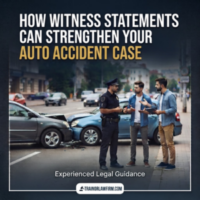
How Witness Statements Can Strengthen Your Auto Accident Case
The moments after a vehicle collision are often a blur of shattered glass, deployed airbags, and severe disorientation. Drivers standing on the shoulder of Interstate 12 or navigating the immediate aftermath of a wreck in downtown Covington frequently experience an adrenaline spike that clouds their memory of the exact sequence of events.
When law enforcement arrives, they are faced with the difficult task of piecing together a chaotic scene based primarily on the conflicting accounts of the drivers involved. This he-said, she-said dynamic is exactly what insurance companies rely on to dispute liability and deny valid personal injury claims.
When the physical evidence is ambiguous and the drivers point fingers at one another, independent eyewitnesses become the foundation of a successful recovery strategy. Their objective observations can confirm your version of events, refute false allegations of fault, and provide the leverage needed to negotiate a fair settlement.
Why Are Independent Eyewitnesses So Important After a Crash?
Independent eyewitnesses provide important, unbiased perspectives that insurance companies and juries find highly credible. Because these individuals have no financial stake in the outcome of your Louisiana auto accident claim, their statements can objectively verify your account of the crash and quickly resolve liability disputes.
When two drivers collide on a busy corridor like Highway 190, the immediate aftermath is rarely calm. Both parties naturally view the crash through the lens of their own perspective, often genuinely believing the other person was at fault.
An at-fault driver might claim they had a green light, or they might insist you swerved into their lane without warning. Without an independent third party to break the tie, insurance adjusters will default to protecting their bottom line, often arguing that liability is split or cannot be proven.
An independent bystander fundamentally changes this equation. These individuals do not know you, they do not know the other driver, and they stand to gain nothing financially from the outcome of a subsequent insurance claim or lawsuit. This inherent lack of bias makes their testimony exceptionally persuasive.
Witness statements serve several vital functions during the early stages of a claim:
- Establishing the exact sequence of events before the impact occurred.
- Confirming which driver had the right-of-way at a contested intersection.
- Providing context about driver behavior, such as excessive speed or aggressive lane changes.
- Corroborating the severity of the impact and the immediate physical condition of the victims.
When a neutral observer confirms your account, it becomes exceedingly difficult for an insurance defense adjuster to fabricate an alternate narrative.
Are Witness Statements Considered Hearsay in Louisiana Courts?
Under Louisiana Code of Evidence Article 801, a written or out-of-court witness statement is generally considered hearsay. However, these statements often become admissible during litigation through specific legal exceptions, or the witness can be subpoenaed to provide direct, sworn testimony during a deposition or trial.
The legal concept of hearsay is frequently misunderstood by injury victims navigating the civil justice system. Hearsay is generally defined as an out-of-court statement offered into evidence to prove the truth of the matter asserted within that statement. Under Louisiana Code of Evidence Article 801, because the person who made the original observation is not on the witness stand being cross-examined, courts are naturally skeptical of admitting these secondhand accounts into the formal trial record.
If a responding officer from the Louisiana State Police writes down what a bystander told them at the scene, that summary in the crash report is technically hearsay. The defense attorney representing the at-fault driver will quickly object if you attempt to submit just the police report as definitive proof of liability at a trial.
Despite this rule, securing these statements immediately remains an absolute priority. Long before a case ever reaches a courtroom in the Civil District Court for the Parish of Orleans, the vast majority of personal injury claims are resolved through aggressive settlement negotiations. During this pre-suit phase, insurance adjusters rely heavily on recorded statements and police reports to evaluate their financial exposure.
If we present a sworn affidavit from a credible bystander detailing exactly how their insured driver ran a red light, the insurance company knows they will lose if the case goes to a jury. They will typically choose to settle rather than risk a public trial where that witness will simply be subpoenaed to testify in person.
What Are the Hearsay Exceptions Under Louisiana Law?
Louisiana law permits several exceptions to the hearsay rule, allowing certain out-of-court statements into evidence. The most common in auto accidents include an excited utterance made under the immediate stress of the crash, or a present sense impression describing the event as it happened.
While the general prohibition against hearsay is strict, the law recognizes that certain spontaneous statements carry a high degree of inherent reliability. When people react to sudden, shocking events, they rarely have the time or the presence of mind to fabricate a lie.
One of the most frequently utilized exceptions is the excited utterance. If a pedestrian standing near a crosswalk in downtown Baton Rouge witnesses a horrific high-speed collision and immediately screams that the truck did not tap the brakes before hitting the other vehicle, that statement may be admitted. The law presumes that the sheer stress and shock of the event strip away the declarant’s ability to consciously manipulate their words.
Another highly relevant exception is the present sense impression. This applies when a person describes an event exactly as it is unfolding or immediately thereafter.
Common scenarios where these exceptions apply include:
- A passenger on a phone call loudly describing another driver swerving aggressively just seconds before an impact.
- A dashboard camera capturing audio of a bystander reacting to a red-light runner in real-time.
Arguing for the admission of these statements in the 22nd Judicial District Court requires a deep understanding of evidential foundations. We meticulously construct the timeline to prove that the statement was made while the observer was still under the direct influence of the chaotic event.
How Do Witness Statements Protect You Under The 51 Percent Fault Rule?
As of January 2026, Louisiana enforces a 51 percent modified comparative fault rule. If an insurance company successfully argues you are 51 percent responsible for the collision, you recover nothing. Witness statements are vital tools to prevent adjusters from unfairly shifting the majority of blame onto you.
The legal landscape for personal injury claims in Louisiana shifted significantly with the implementation of Act No. 15. The state moved away from a pure comparative fault system, adopting a much stricter 51 percent modified comparative fault standard codified under Louisiana Civil Code Article 2323. This change drastically altered how insurance companies defend against large injury claims.
Under the current law, your financial recovery is reduced by your assigned percentage of fault. If a jury determines you were 20 percent responsible for a crash because you were slightly speeding, a one hundred thousand dollar award is reduced to eighty thousand dollars.
The critical danger lies at the 51 percent threshold. If the defense can convince a judge or jury that you bear 51 percent or more of the liability, you are completely barred from recovering any damages whatsoever.
Defense attorneys now dedicate immense resources to pushing a plaintiff’s fault percentage just over that line. They will scrutinize your every action, looking for any minor infraction to weaponize against you.
Independent testimony is the strongest shield against this aggressive tactic. A credible bystander can systematically dismantle the defense’s attempts to shift the blame by confirming:
- You had established control of the lane well before the other vehicle attempted a sudden merge.
- Your headlights were appropriately activated during heavy rain or twilight conditions.
- The at-fault driver accelerated to beat a yellow light rather than slowing down.
By locking in these factual observations early, we prevent insurance adjusters from fabricating a narrative that places the majority of the blame squarely on your shoulders.
What Specific Details Should a Good Witness Statement Contain?
A strong witness statement must include the observer’s exact location, their line of sight, and a detailed description of the events leading up to the impact. It should also document the weather, traffic conditions, vehicle speeds, and the immediate aftermath of the collision.
A vague assertion that the blue car caused the crash holds very little weight in a formal legal proceeding. To be effective, an observer’s account must be highly detailed, chronologically logical, and focused on specific factual observations rather than emotional opinions.
When our legal team tracks down individuals who saw a collision, we conduct thorough, structured interviews designed to extract the precise data points that establish liability. We then draft these accounts into formal, sworn affidavits to ensure they meet all legal formatting requirements.
Essential components of a powerful sworn statement include:
- The individual’s full legal name, current residential address, and reliable contact information.
- Their exact physical location at the time of the collision.
- Confirmation that their line of sight was unobstructed by large trucks, foliage, or buildings.
- A step-by-step chronological narrative of the vehicle movements leading up to the crash.
- Specific observations regarding estimated vehicle speeds, sudden braking, or erratic steering.
- A formal signature, date, and notarization to elevate the document from a casual note to a legally binding affidavit.
Capturing this level of detail requires acting swiftly before the individual’s memory of the event becomes influenced by news reports or conversations with other people.
How Do You Gather Contact Information at a Chaotic Crash Scene?
If you are physically able, use your phone to record a quick audio clip or take a photo of a bystander’s business card or license plate. Focus solely on collecting their name and phone number so your attorney can contact them for a formal statement later.
The minutes immediately following a severe impact are often defined by shock, physical pain, and overwhelming confusion. The priority is always securing emergency medical care. If you have suffered broken bones or a traumatic head injury, you should not be walking around the debris field trying to conduct interviews.
However, if you are physically capable and safely out of the flow of traffic, taking a few seconds to identify the people who stopped to help can drastically alter the trajectory of your claim. Bystanders often pull over to ensure everyone is alive, but they frequently leave the scene before law enforcement arrives to take their official statements.
Effective methods for quickly capturing contact details include:
- Opening the voice memo app on your smartphone and asking the person to state their name and phone number clearly.
- Taking a quick, high-resolution photograph of their driver’s license or a business card.
If you are transported directly to a facility like University Medical Center New Orleans or a regional hospital in Tangipahoa Parish, our legal team takes over this investigative burden. We review the police report for any mentioned names, canvass local businesses for security footage that might have captured pedestrians, and utilize digital tools to track down individuals who may have witnessed the collision but left before speaking to an officer.
Can Passengers in Your Vehicle Provide Valid Testimony?
Yes, passengers in your vehicle can provide valid testimony regarding the collision. While insurance adjusters may try to undermine their credibility by arguing they are biased, their firsthand accounts of the driver’s actions and the moments before impact remain highly valuable evidence.
A common misconception is that the testimony of a passenger riding in your vehicle is legally useless simply because they are a friend or family member. While it is true that an insurance defense lawyer will aggressively attempt to paint a spouse or a close friend as heavily biased, their firsthand observations of the crash are entirely valid and admissible pieces of evidence.
Passengers possess a unique vantage point that external bystanders lack. They can testify to what was happening inside your vehicle immediately prior to the crash. A passenger can confidently state under oath that you were looking straight ahead, holding the steering wheel with both hands, and driving the posted speed limit.
Strategies for validating passenger testimony include:
- Matching their description of the impact angle with the forensic damage on the vehicles.
- Aligning their timeline of events with the data pulled from the vehicle’s event data recorder (black box).
When a passenger’s detailed narrative aligns flawlessly with the undeniable physical facts of the crash, the defense’s attempts to dismiss them as merely biased quickly fall apart in front of a jury.
What Happens If a Witness Changes Their Story Later?
If an eyewitness alters their account months after the crash, an attorney can use their initial recorded statement or police report interview to challenge their new narrative. Promptly securing a signed or recorded statement locks in their memory while the event is still fresh.
Human memory is remarkably fragile. Over time, individuals who witnessed a traumatic event may begin to doubt their own recollections, blend their memories with things they read online, or simply forget key details entirely. When a civil lawsuit takes months or years to reach a deposition, a bystander who was once your strongest advocate might suddenly give vague or contradictory answers.
Insurance companies thrive on this ambiguity. If a bystander changes their story during a deposition, the defense will immediately use that inconsistency to attack their overall credibility and cast doubt on your entire claim.
This is precisely why time is of the essence. By securing a detailed, signed affidavit or a formal recorded interview within days of the collision, we effectively lock in their testimony while the facts are sharp.
If that individual later attempts to change their story on the witness stand, we can utilize a legal mechanism known as recorded recollection. If a person cannot fully remember an event, a memorandum or record made when the matter was fresh in their memory can be read into evidence. We can also use their initial, detailed statement to aggressively cross-examine them, forcing them to admit that their memory on the day of the crash was far more accurate than their memory two years later.
Holding Negligent Drivers Accountable in St. Tammany Parish
The physical and financial toll of a severe vehicle collision can devastate a family for years. When insurance companies attempt to exploit the chaos of a crash to deny responsibility, you need an aggressive legal strategy backed by undeniable evidence. The experienced team at Trainor Law Firm knows how to locate bystanders, secure airtight affidavits, and build compelling cases that withstand the scrutiny of the courtroom.
Attorney Brian F. Trainor, a former Assistant District Attorney, brings a deep understanding of evidential standards and courtroom strategy to every personal injury claim. We meticulously investigate crashes across St. Tammany Parish, Orleans, Jefferson, Washington, Livingston, and East Baton Rouge to ensure the true at-fault parties are held fully accountable for the harm they cause.
We handle all personal injury matters on a contingency fee basis, which means you do not pay any attorney fees unless we win your case. If you are struggling with severe injuries following a collision, do not let the insurance company dictate the narrative. Contact our Covington office at 985-900-2250 today to schedule a comprehensive, free consultation.
Frequently Asked Questions
Can an anonymous 911 caller be used as a witness?
While the audio of an anonymous 911 call can sometimes be admitted to show the immediate danger or the timeline of a crash, it is difficult to rely on an unidentified caller to prove complex liability. Without knowing the caller’s identity, an attorney cannot subpoena them for a deposition or cross-examine them regarding their line of sight. We work closely with law enforcement and utilize digital discovery to trace these calls and identify the caller whenever possible.
Will the police automatically collect statements from everyone?
No, responding officers are often overwhelmed securing the scene, redirecting traffic, and coordinating with paramedics. They frequently only speak to the drivers involved and perhaps one or two bystanders who proactively approach them. It is highly common for people who saw the crash to drive away before an officer ever has the chance to ask for their name.
Do witnesses have to show up in court?
If a case proceeds all the way to a formal trial, individuals who observed the crash can be legally subpoenaed to appear in court and testify under oath. However, the vast majority of personal injury cases settle long before a trial becomes necessary. Often, a strong, sworn affidavit provided during the negotiation phase is enough to force the insurance company to offer a fair settlement.
Can traffic camera footage replace the need for an eyewitness?
High-quality traffic camera or dashcam footage is incredibly powerful evidence, but it rarely captures the entire context of a collision. Cameras often have blind spots, poor resolution, or may only record a few seconds of the impact itself. A human observer can provide vital context about driver behavior, erratic driving miles before the impact, and the immediate verbal admissions made by the drivers right after the crash.
What if the only witness is a minor?
A minor can absolutely provide valid testimony regarding an auto accident, provided they are old enough to understand the difference between truth and a lie and can accurately communicate their observations. Courts evaluate a child’s competency to testify on a case-by-case basis. Their statements are handled with care, often requiring the presence of their parents or guardians during interviews, but their firsthand accounts remain highly valuable in establishing liability.