

The Dangers of Traumatic Brain Injuries from Oil Rig Accidents
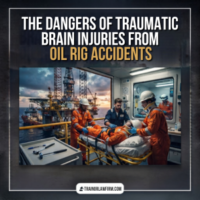
A sudden blast on an offshore deck, a heavy drill pipe swinging out of control, or a slick walkway on a floating rig off the coast of Houma can transform a routine shift into a life-altering medical catastrophe in a fraction of a second.
Offshore roughnecks, drillers, and crane operators work in some of the most unforgiving industrial environments in North America. When high-pressure machinery fails or vessel owners cut corners on safety protocols in the Gulf of Mexico, the human skull often absorbs the kinetic energy of that negligence.
Traumatic brain injuries sustained on oil rigs are notoriously complex. Unlike a broken bone that shows up clearly on a standard x-ray, damage to microscopic neural pathways can produce subtle, delayed symptoms that destroy a worker’s career long before an insurance company acknowledges the true severity of the harm.
How Do Traumatic Brain Injuries Commonly Occur on Louisiana Oil Rigs?
Traumatic brain injuries on Louisiana oil rigs frequently result from falling objects, swinging cables, high-pressure equipment blowouts, and slip-and-fall accidents on slick decks. The hazardous nature of offshore drilling, combined with heavy machinery and unpredictable weather in the Gulf of Mexico, creates a high-risk environment for severe head trauma.
Working on an oil rig requires constant movement around massive, high-energy equipment operating under thousands of pounds of pressure. When safety standards slip or crew members are pushed through extreme fatigue during extended hit shifts, catastrophic head impacts become an impending reality.
One of the leading causes of head trauma on semi-submersibles and drillships operating off the Louisiana coast is dropped objects. Heavy steel tongs, shackle pins, or hand tools falling from the derrick can strike a roughneck on the drill floor with lethal force, easily crushing protective hard hats.
Common operational hazards that lead to severe brain trauma include:
- Unsecured drill pipe or collar loads swinging unexpectedly during crane transfers.
- High-pressure line ruptures and hydraulic blowouts that throw workers violently against steel bulkheads.
- Slippery mud decks, unmaintained catwalks, and grease-slicked ladders that cause high-elevation falls.
- Mooring line snaps and cathead cable whipping incidents during heavy weather operations.
- Structural failures or explosions caused by gas buildup in unventilated compartments.
The sheer kinetic force involved in these industrial incidents frequently causes the brain to impact the interior of the skull. This violent acceleration and deceleration damages fragile cerebral tissue even when the outer skull remains completely intact.
What Are the Hidden Symptoms of a Mild or Severe TBI?
Symptoms of a traumatic brain injury may not appear immediately after an offshore accident. Workers often experience delayed confusion, chronic headaches, blurred vision, memory loss, emotional volatility, and severe sleep disturbances. Even a seemingly minor concussion can develop into a debilitating condition known as post-concussion syndrome.
In the high-pressure culture of offshore drilling, rig hands are routinely conditioned to tough it out after a bump on the head. Adrenaline, combined with fear of losing employment or being sent ashore, leads many injured workers to minimize initial disorientation.
This is an exceptionally dangerous scenario. A blunt force strike to the head often triggers microscopic axonal shearing, localized brain swelling, or slow intracranial bleeding that manifests gradually over days or weeks.
Critical neurological symptoms that demand immediate specialist evaluation include:
- Persistent, throbbing headaches that escalate in severity over several days.
- Uncharacteristic irritability, sudden emotional outbursts, or profound personality changes.
- Memory gaps, difficulty concentrating, and cognitive fatigue during basic daily tasks.
- Sensitivity to bright light, persistent ringing in the ears, or chronic balance issues.
- Profound disruptions in sleep patterns, including chronic insomnia or severe lethargy.
Ignoring these early warning signs can lead to permanent cognitive impairment. When a worker is evacuated to a Level I trauma center like University Medical Center New Orleans, comprehensive neuroimaging and specialized cognitive testing are vital to establish an accurate baseline of the neurological damage.
Are Offshore Workers Covered by Standard Workers Compensation?
Standard state workers compensation generally does not apply to offshore oil rig accidents. Instead, injured maritime workers seek financial recovery through specialized federal laws, including the Jones Act, the Longshore and Harbor Workers Compensation Act, or the Outer Continental Shelf Lands Act, depending on their specific job duties.
Injury claims occurring on water or fixed platforms off the Louisiana coast fall under federal maritime jurisdiction rather than state civil code. Standard state no-fault workers compensation statutes generally offer zero protection to men and women injured on floating rigs, drillships, or barges. Instead, your specific job title and the physical location of the rig determine which statutory framework governs your claim under 46 U.S.C. Section 30104, which codifies the landmark Jones Act.
If you spend at least thirty percent of your working time in service of a navigable vessel in navigation, such as a jack-up rig, barge, or drillship, you qualify as a seaman. This classification grants you the right to sue your employer directly for maritime negligence.
If you are a land-based contractor or work exclusively on a fixed, non-floating production platform anchored on the Outer Continental Shelf, your recovery is governed by federal administrative workers compensation under the Outer Continental Shelf Lands Act and the Longshore and Harbor Workers Compensation Act. Discerning these jurisdictional boundaries early is essential to protecting your legal rights.
What Is the Difference Between a Jones Act Claim and An Unseaworthiness Claim?
A Jones Act claim targets the employer for negligence, requiring proof that their actions contributed to the brain injury. An unseaworthiness claim under general maritime law targets the vessel owner, applying strict liability if defective equipment, inadequate staffing, or unsafe conditions caused the offshore accident.
When a maritime employee suffers a traumatic brain injury aboard a vessel in the Gulf of Mexico, federal law provides two distinct legal pathways for financial recovery that are routinely pursued simultaneously.
A Jones Act claim is grounded in employer negligence. Under this federal statute, the legal burden of proof is famously light. You only need to demonstrate that your employer’s failure to provide a reasonably safe work environment played even the slightest part in causing your head trauma. This includes inadequate crew training, unsafe work quotas, or failing to enforce proper hard hat protocols.
An unseaworthiness claim is entirely separate from negligence and stems from general maritime law. A vessel owner owes an absolute, non-delegable duty to provide a vessel that is reasonably fit for its intended purpose.
- Unseaworthy conditions that frequently cause severe head injuries include:
- Defective derrick equipment, worn crane cables, or malfunctioning high-pressure relief valves.
- An improperly trained or chronically undermanned crew forced to perform complex rig maneuvers.
- Lack of non-skid coatings on exposed walkways subject to sea spray and drilling mud.
- Absence of mandatory safety guards on rotating machinery and spinning tables.
Because unseaworthiness imposes strict liability, the vessel owner can be held accountable for a defective piece of equipment even if they had no prior knowledge that the gear was broken.
How Does Maintenance and Cure Help Injured Maritime Workers?
Maintenance and cure is an ancient maritime principle requiring vessel owners to pay an injured seaman’s daily living expenses and medical bills until they reach maximum medical improvement. These vital benefits must be provided promptly, regardless of who was at fault for the traumatic brain injury.
Long before a formal lawsuit reaches trial or settlement, an injured seaman requires immediate financial support to survive while off the rig. Under general maritime law, maintenance and cure represents an automatic, non-negotiable right that attaches the moment a worker is injured in the service of a vessel.
Maintenance is a daily stipend intended to cover basic household living expenses ashore, including rent, utilities, food, and property taxes. Cure represents the employer’s absolute obligation to pay for all necessary medical care, emergency evacuations, specialized diagnostic imaging, surgeries, and ongoing neurological therapy.
Key aspects of maintenance and cure obligations include:
- Absolute fault independence: You are entitled to benefits even if your own mistake caused the accident.
- Freedom of medical choice: You have the legal right to choose your own treating neurologists and doctors.
- Mandatory continuation: Payments must continue until a physician certifies you have reached Maximum Medical Improvement.
- Severe legal penalties: Employers who arbitrarily deny or delay benefits face punitive damages and legal fees.
Reaching Maximum Medical Improvement means your condition has stabilized and further medical treatment will not yield improvement. For severe brain injuries requiring years of cognitive rehabilitation, reaching this point can take a substantial amount of time.
Can I Still Recover Compensation If I Was Partially at Fault for the Accident?
Yes, injured maritime workers can still recover compensation even if they were partially at fault. Federal maritime law applies the doctrine of pure comparative fault, meaning your financial recovery is proportionally reduced by your percentage of blame, rather than barring your claim entirely.
Offshore drilling companies and their corporate insurance adjusters routinely attempt to blame injured workers for their own head trauma. Defense lawyers will claim you failed to pay attention, breached rig safety rules, or improperly positioned yourself near swinging loads.
Under Louisiana state personal injury law, strict modified comparative fault rules can completely destroy a victim’s claim if they are assigned fifty-one percent or more of the blame. However, maritime law operates under a completely different, pro-worker doctrine known as pure comparative fault.
Under pure comparative fault, an injured seaman is never completely barred from recovery unless they were one hundred percent at fault.
- If a jury determines your total brain injury damages equal two million dollars:
- And finds your employer ninety percent at fault for providing a defective crane cable.
- While assigning ten percent fault to you for standing near the swing path.
- Your net recovery is reduced by ten percent, resulting in a one point eight million dollar recovery.
Our legal team aggressively fights back against fault-shifting tactics by analyzing drill logs, equipment inspection records, and eyewitness testimony to prove the primary failure rested entirely with corporate management.
What Is the Statute of Limitations for Filing a Maritime Injury Lawsuit?
Under federal maritime law, the statute of limitations to file a lawsuit for a traumatic brain injury is typically three years from the date of the accident. However, failing to report the injury immediately to your employer can severely jeopardize your claim long before this deadline approaches.
Time is a relentless enemy following an offshore disaster. Under uniform federal maritime legislation codified in 46 U.S.C. Section 30106, an injured maritime worker generally has three years from the date of the incident to initiate a formal lawsuit for personal injury or unseaworthiness.
While three years may sound like a generous window, waiting to take legal action is a critical mistake. Offshore oil platforms are highly dynamic environments. Rigs are routinely moved, derrick equipment is repaired or altered, and corporate maintenance logs can mysteriously vanish if not legally preserved through spoliation letters.
Furthermore, rig crew members live across the country and rotate off hit schedules constantly. Tracking down vital eyewitnesses who saw the dropped pipe or the equipment failure becomes significantly harder as months pass.
Additionally, most maritime employers enforce strict internal reporting rules requiring written notification of an injury within twenty-four to forty-eight hours. Delaying your official incident report gives insurance adjusters an excuse to argue that your brain trauma occurred ashore rather than on the rig.
What Damages Are Available for a Severe Neurological Injury?
Victims of severe offshore head trauma can pursue extensive damages, including past and future medical expenses, cognitive rehabilitation costs, lost wages, and profound loss of future earning capacity. Additionally, maritime law allows recovery for non-economic damages such as physical pain, mental suffering, and loss of enjoyment of life.
A traumatic brain injury rarely affects just the individual; it impacts every dimension of a family’s financial and emotional survival. When an offshore hand suffers permanent neurological damage, returning to high-paying maritime labor is often physically and cognitively impossible.
Calculating the true lifetime financial impact of a brain injury requires detailed economic projections and expert testimony from vocational rehab specialists, neurologists, and life care planners.
A comprehensive maritime injury claim seeks full financial recovery for:
- Lifetime medical care: Surgeries, specialized prescription medications, and long-term residential care facilities.
- Cognitive therapy: Specialized occupational therapy, speech therapy, and neuro-psychological care.
- Total lost wages and future earning capacity: Compensation for the decades of offshore income you can no longer earn.
- Non-economic losses: Compensation for severe physical pain, emotional distress, depression, and loss of life quality.
- Spousal loss of consortium: Damages for the profound disruption to family relationships and household support.
By building an evidence-based narrative of your past contributions and future medical needs, we push insurance defense teams to offer full compensation that secures your family’s future.
Holding Negligent Maritime Employers Accountable in Louisiana
The physical, emotional, and financial devastation following an offshore head trauma can leave injured workers feeling isolated and overwhelmed. Corporate oil companies and maritime insurers deploy teams of lawyers immediately after a rig disaster to minimize their payout. You deserve a dedicated legal advocate fighting just as aggressively for your rights.
Attorney Brian F. Trainor, a former Assistant District Attorney, brings extensive courtroom trial experience and deep legal knowledge to every complex offshore injury claim. We meticulously investigate oil rig accidents across Louisiana, including maritime claims originating off the coasts of St. Tammany Parish, Houma, Lafayette, New Orleans, and Port Fourchon.
We handle all maritime personal injury matters on a contingency fee basis, which means you pay absolutely no attorney fees unless we win your case. Do not let a corporate claims adjuster dictate the value of your future. Contact our Covington office at 985-900-2250 today to schedule a comprehensive, free consultation.
Frequently Asked Questions
Do I have to see the company doctor for my head injury?
No, you are not legally required to treat exclusively with a doctor chosen by your employer or their insurance carrier. Under federal maritime law, an injured seaman has the absolute right to select their own independent treating physician and specialists. Company doctors frequently prioritize returning workers to the rig quickly over thorough diagnostic care. You should consult an independent neurologist immediately.
What happens if my employer stops paying my maintenance and cure?
If your employer arbitrarily or callously terminates your maintenance and cure benefits before an independent physician certifies you have reached Maximum Medical Improvement, they are breaching federal maritime law. An experienced maritime attorney can file an emergency motion in court to compel reinstatement of benefits. Furthermore, if the court finds the refusal was willful, your employer can be ordered to pay punitive damages and your legal fees.
Can I be fired for reporting a head injury on an oil rig?
It is illegal for an employer to retaliate against, demote, or terminate an offshore worker simply for reporting an on-the-job injury or filing a legitimate Jones Act claim. Retaliatory discharge violates federal maritime public policy. If your employer fires you for seeking legal representation or reporting your brain injury, you may file an additional lawsuit for wrongful termination and retaliatory damages.
How do I prove my TBI if the MRI comes back normal?
Standard hospital CT scans and routine structural MRIs are designed to detect major skull fractures or large bleeding events, often missing microscopic axonal shearing and subtle neural pathway damage. Proving a traumatic brain injury with normal structural imaging requires specialized diagnostic tools, such as Diffusion Tensor Imaging (DTI), Functional MRIs, or comprehensive neuropsychological testing batteries administered by board-certified specialists.
Does the Outer Continental Shelf Lands Act apply to jack-up rigs?
No, jack-up rigs are legally classified as vessels under federal maritime law because they are capable of navigation when lowered and towed between offshore locations. Therefore, workers injured on jack-up rigs generally qualify as seamen under the Jones Act rather than falling under the Outer Continental Shelf Lands Act. Determining the exact legal classification of the offshore structure is a critical step in establishing jurisdiction.